
Factoring a polynomial
Binomials
- Difference of squares
- Suma o diferencia de cubos Sum or difference of cubes
- Suma o diferencia de potencias impares iguales Sum or difference of odd powers equal
- Trinomios Trinomials
- Trinomio cuadrado perfecto Perfect square trinomial
- Trinomio de la forma x²+bx+c Trinomial of the form x ² + bx + c
- Trinomio de la forma ax²+bx+c Trinomial of the form ax ² + bx + c
- Polinomios Polynomials
- Factor común Common Factor
Case I - Common Factor
Remove the common factor is to extract the common literal a polynomial, binomial or trinomial with the smallest exponent and the common divisor of its coefficients.Common monomial factor
Common Factor by grouping terms

Common Factor polynomial
First you determine the common factor with the coefficients of the variables (that with smallest exponent). It takes into account the common factor here not only has a term, but two.
an example:

It makes clear that it is repeating the polynomial (xy), then this will be the common factor. The other factor is simply what remains of the original polynomial, ie:

The answer is:

In some cases we must use the number 1, for example:

It can be used as:

So the answer is:

Case II - Factor by grouping common terms
To work a polynomial by grouping terms, one must bear in mind that these are two characteristics that are repeated. Is identified because it is an even number of terms. To resolve this, each cluster of characteristics, and is applied to the first case, namely:


A numerical example can be:

then can be grouped as follows:

Apply the first case (common factor)


Case III - perfect square trinomial
It is identified by three terms, two of which have exact square roots and the remaining product is twice the roots of the first times the second. To troubleshoot a TCP leaving we must rearrange the terms of first and third terms that have a square root, then extract the square root of the first and third terms and we write them in a parenthesis, separated by the sign that accompanies the second term, closing elevate the parentheses around the binomial squared.

and

Example 1:

Example 2:

Example 3:

Example 4:

Organizing the terms we have

Extracting the square root of the first and last term and grouped in parentheses separated by the second term and squaring we have:

Case IV - Difference of Squares
It is identified by having two squared terms and united by a minus sign. Be it resolved by means of two brackets (similar to the products of the form (ab) (a + b), one negative and one positive.

Or in a more general exponents pairs:

And using a productoria we can define a factorization for any exponent, the result gives r +1 factors.

Example 1:

Example 2: Suppose all r, r = 2 for this example.



Factoring difference of squares or subtraction is to obtain the square root of each term and represent these as the product of conjugate binomials.
Case V - Trinomial perfect square by adding and subtracting
It is identified by three terms, two of them are perfect squares, but the rest should be complete by the sum to be the double product of its roots, the value is the same amount is subtracted for the original exercise change.

Case VI - Trinomial of the form x 2 + bx + c
It is identified by three terms, there is a literal with exponent to square one is the independent term. Resolved by two brackets, which are placed in the square root of the variable, for two numbers that multiplied the term result in independent and combined (may be negative numbers) result the term of the medium.
Example:

Example:

Example:

Case VII sum or difference of powers to the n
The sum of two numbers to the power n, a n + b n is decomposed into two factors (where n is an odd number):
Being as follows:

Example:

The difference is also factorable and in this case no matter whether n is even or odd. To give as follows:

Example:


The differences, either square or cube emerging from a particular case of this generalization.
Case VIII Trinomial of the form ax 2 + bx + c
In this case we have 3 lines: The first term is a perfect square, square root bone that is accurate, the second term is half the exponent of the previous term and third term is an independent term, osea no literal part and :

To factorize an expression of this form coje first term next to x 2, (in this case 4) and multiplied by the whole expression, leaving the same but the second term in parenthesis and leaving all in a fraction. 1 Using as denominator the term that we are multiplying, multiplying by 1

Then separated into two parts the term
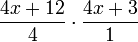
And then proceed to remove the fractions


